The Real Question of the AI Era: What Do You Own?
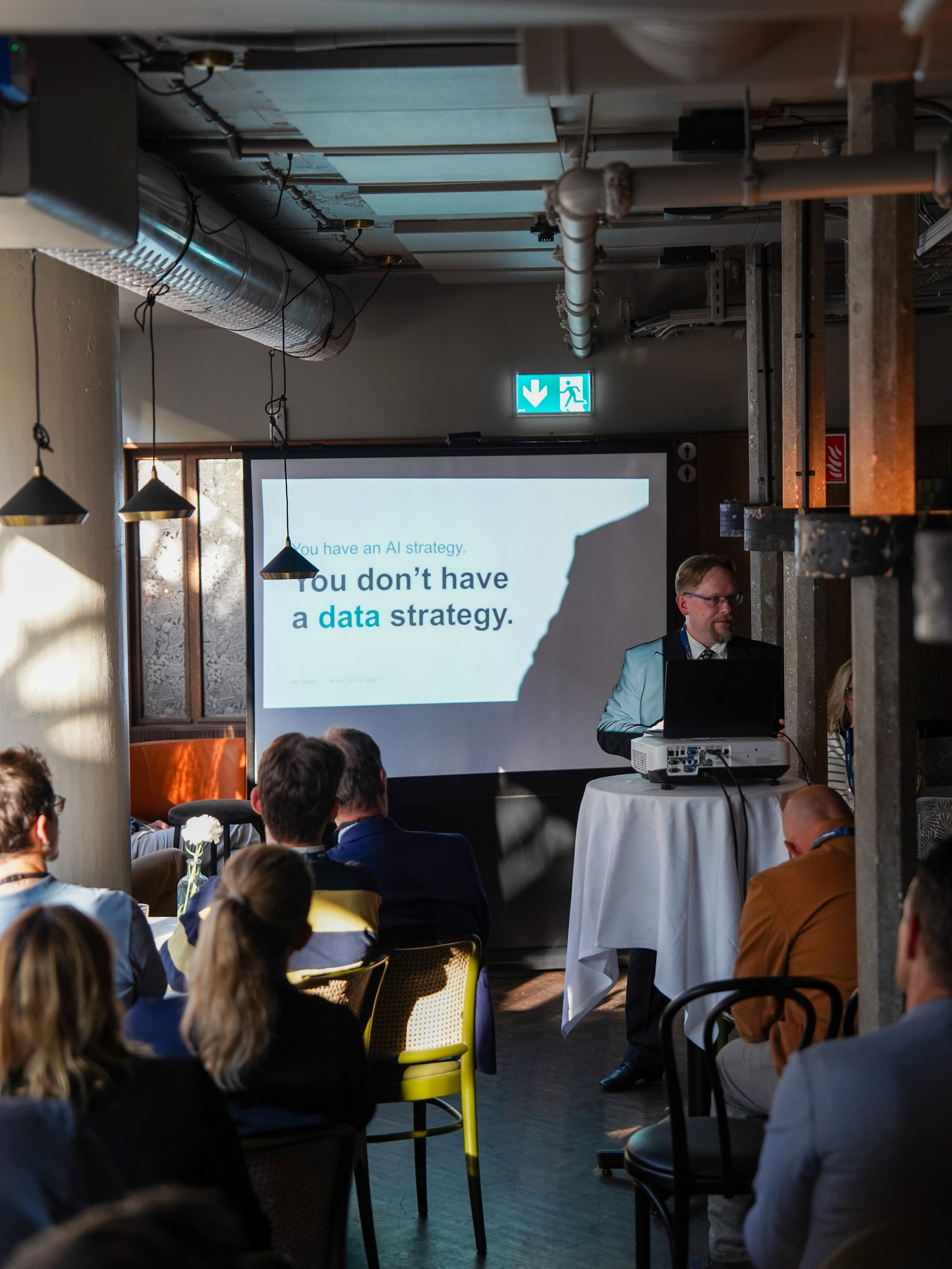
While businesses rush to build an AI strategy, Media Tailor board member Ari Salmi argues that they are missing a crucial step: without a solid data strategy, AI is built on thin air.
When discussing artificial intelligence, conversations naturally gravitate toward algorithms and fast-paced tech tools.
At our 2-year anniversary event in Stockholm, our board member Ari Salmi—a seasoned tech leader with 15 years at Nokia, a background at Qt Company, and extensive experience guiding platform strategies—highlighted during his keynote speech that the focus should be elsewhere.
Rather than talking merely about AI itself, Salmi emphasized the broader transformation: what this AI era has actually given us, and the critical question it forces every organization to answer.

There is no denying that the AI era has handed us a huge amount of tools, fast-tracking development cycles so quickly that we can barely keep up. Yet, alongside these speed boosts came a fundamental challenge. It has forced us to ask a question that has been shifting right beneath our feet: What do we actually own?
The answer is simple, yet profound: We own our data. But what does that really mean in practice?
The ground truth
Looking back over the past 30 years, the tech industry had gone through four or five major technological jumps. Each shift brought its own defining question:
- In the mobile era, everyone asked: “Where are your customers?”
- With the rise of cloud systems, the question shifted to: “Where is your infrastructure, and who owns it?”
- Today, the core question facing every leader has become: “What do you own?”
To illustrate this, Salmi offered a concrete example from the media archive world. Imagine a broadcast tape from 30 years ago. Eventually, it was digitized onto a hard drive, aired once in a live show, and then left untouched on a shelf. No indexing, no extracted metadata, just a hard drive with a blinking light.
Fast forward to today: we can drop that old footage directly into an AI model. We can ask the model to index it, generate transcriptions, identify faces, or even “speak” with the data to explain what actually happened.
While this sounds revolutionary, Salmi pointed out that doing this is no longer a unique competitive advantage. Anyone, including your competitors, can drop media into an AI model.
The real differentiator lies deeper: the entire model interpretation is driven by your data.
In software development, people talk about the “source of truth.” In the AI world, we call it the “ground truth.” What questions does your data actually answer? If a company knows this, it is in great shape. But realistically, as Salmi notes, most companies today do not know the answer.
Data strategy belongs in the boardroom
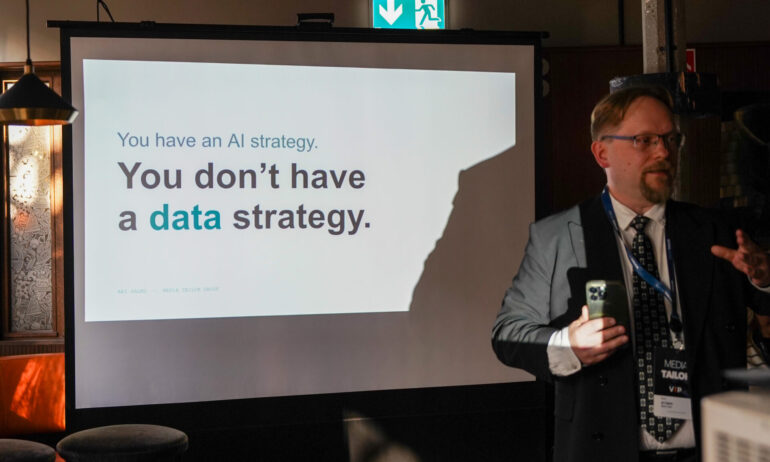
While every business is rushing to build an AI strategy—and Salmi admitted with a smile that he, as well, serves on the board as the “AI strategy guy”—the true prerequisite is a data strategy.
Building a data strategy is not inherently difficult, but Salmi stressed that it has to happen at the leadership and board levels. It’s emphatically not just an IT project. You cannot simply delegate it to the IT department and ask them to figure out where to save files and for what purpose.
Instead, board meetings need to treat data with the same weight as financial metrics. Board members need to ask:
- What data do we actually own today, and how are we using it?
- What enrichment are we adding over that data, and do we want to keep it? The metadata created over your assets—transcriptions, titles, tags—is your data, even if AI analyzed it. Do you want to keep that value or sell it off?
- What do we want to build on top of it? Should we run a pilot? Can we build a better, more tailored product for our customers now that we truly understand our own data?
By having these foundational discussions inside the board and executive team, companies don’t need massive change management projects or endless new hires. They simply need a clear data strategy for how they want to work with their assets.
The Nordic & European advantage
Salmi looks at this from a Nordic and European perspective, where privacy and security are top of mind.
Everyone is asking: “Where do you save your data? Which model are you using? Are you exposing your data to the US, and how do you handle privacy?”
Fortunately, European and Nordic companies have an advantage here. As Salmi pointed out, we are accustomed to handling safety and privacy, it’s ingrained in how we operate. What might feel like a regulatory burden is actually a massive competitive advantage.
European organizations are a step ahead of where the rest of the world is going. We understand how GDPR works and how the European AI Act functions. We are already securing our own data while others are still figuring it out. And by combining Nordic and European forces, local players can stand strong against global tech giants entering the market.

The foundation of everything
As Salmi reflected on Media Tailor’s journey—30 years in Finland and two years in Sweden—he noted that the core mission has always been clear. For three decades, the focus has been on keeping customer data safe in the right premises, serving it reliably to broadcasting workflows, and operating behind the scenes.
Managing infrastructure and data behind the scenes has not always been seen as the most fashionable business, he admitted, but added: “Today, it has proved to be the most critical.”
It is the foundation of everything. If you know your data and control your infrastructure, whatever AI layer you build on top will succeed.
As Salmi concluded, “That is the ground truth. Let’s not give it away.”

Ari Salmi is a Board Member at Media Tailor, a serial entrepreneur, and a veteran of AI product development.
He currently works in ad tech, building AI-driven contextual targeting solutions for CTV environments, backed by a 30+ year career in software development and scaling engineering organizations.
Related articles
 News
Media Tailor Strengthens Board with Ari Salmi to Accelerate Growth
Oulu-based Ari Salmi brings further invaluable technology expertise to the Media Tailor Board of Directors.
 Blog
When AI Tools Are the Same for Everyone, Competition Shifts from Features to Implementation
The true competitive advantage of AI tools depends on how…
 Blog
The Golden Age of Metadata
Vectors, XMP, EXIF, IPTC, JSON, Avro, Parquet, Big Data—the list grows and expands with every new technology. Leveraging and storing metadata is not a new concept.
 News
2 Years in Sweden – Now Strengthened By a New Office in Stockholm
We’ve been operating in Sweden for two years now, but Media Tailor’s international journey just…